
Simple CRM Pricing for Small Business
Start for free. Keep it simple. Grow when you’re ready.
Sign-up with every feature you’re promised on day one,, with transparent pricing built for UK small businesses.

No contracts

No setup fees

No hidden fees
4.9/5 on Google – Trusted by hundreds of UK small businesses | 🇬🇧 UK-based support
Choose your CRM package
Choose the Popcorn package that’s right for your business, with flexible options designed to give you the tools and support you need to grow.

Free CRM
£0
Perfect for getting you organised and on track
What’s included:
One user account to manage your CRM.
See your key tasks, reminders and contacts at a glance.
Keep important information organised and never miss a follow-up.
Store and manage up to 250 customer and prospect contacts.
Track your opportunities and manage your sales process in one pipeline.

All Features
£59 / mo
Everything you need to manage, nurture and convert opportunities
What’s included:
One user account with access to all popcorn CRM features (Additional team members available to add)
Send up to 3,500 marketing emails each month.
Marketing tools inc. website tracking to nurture & identify opportunities.
Stay organised with reminders and keep prospects moving along the journey.
Manage deals, improve visibility automate workflows & close more.
Email marketing & WhatsApp allowances.
UK-based support & a free 30 min onboarding session.

Onboarding packages
£0 to £499
Choose optional expert help if you’d like it (All Features package only)

Starter – £0
Get started with popcorn at your own pace with basic guidance and support.

Enhanced – £99
Get personalised 1-to-1 support, data import and guidance to get you started with confidence.

Kickstart – £199
Get your essential setup completed, including data import, pipeline setup and an email template.

Success – £499
Get fully set up with tailored guidance, automation, customer journeys and ongoing support.

Get our £99 enhanced onboarding FREE!
When you sign up within 14 days of a demo or sign up without a demo
Already looked at HubSpot?
Here’s what small businesses tell us made them switch to popcorn instead.
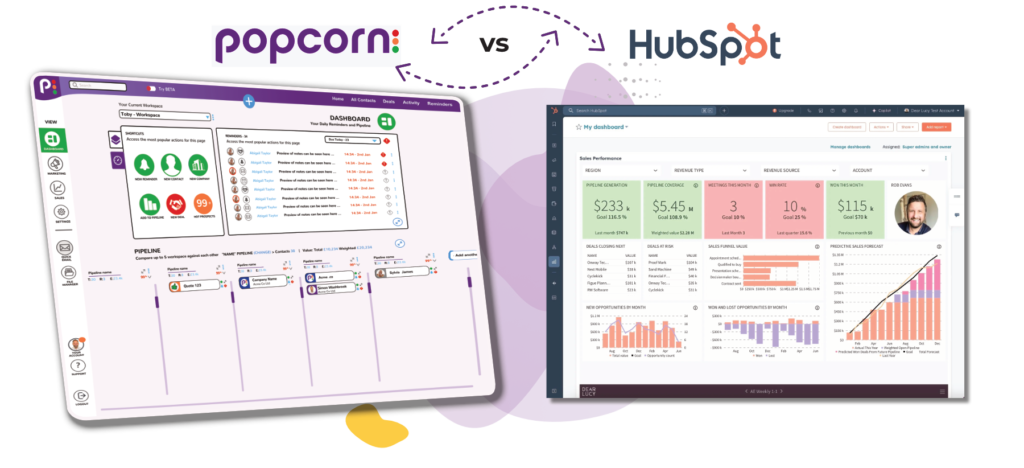
Example comparison: popcorn vs HubSpot for a 3-user team
A 3-user team sending up to 3,500 emails and 1,000 WhatsApp messages a month — both within popcorn's standard allowances — pays £99 a month with popcorn. The same usage on HubSpot Marketing Hub Professional costs £702 a month (3-seat minimum) plus a one-off ~£2,370 onboarding fee — a saving of roughly £603 a month, or over £9,600 in year one once HubSpot's onboarding fee is included.
Figures exclude VAT. HubSpot figures are converted from their published USD pricing (~$1 = £0.79) since HubSpot doesn't publish GBP pricing for this tier. Use the calculator above for your own team size and usage.
popcorn vs HubSpot calculator
What would you actually pay?
Tell us your team size and usage — we'll show you popcorn vs HubSpot side by side.
Takes 10 seconds · no email required
Every HubSpot number used in this calculator (seat price, onboarding fee, WhatsApp limit) is pulled from HubSpot's own published pages, not estimated. Check the originals yourself:
You'll need to select any email or WhatsApp credits above the standard allowance during signup — this link takes you to the base package for your team size.
Book a free demo insteadAll figures shown exclude VAT. popcorn's list prices are already ex-VAT, and HubSpot's published USD prices are also ex-VAT, so both sides compare like-for-like without conversion. GBP for HubSpot is an approximate conversion (~$1 = £0.79, Aug 2026) since HubSpot doesn't publish GBP pricing for this tier. HubSpot's WhatsApp overage assumes $70 per additional 1,000 messages, based on HubSpot's own support guidance — the exact block size beyond 1,000 isn't independently confirmed.
See how popcorn CRM compares to HubSpot, Zoho, plus many more:
Common CRM questions from small business owners
Choosing a CRM isn’t just about finding the lowest monthly price. You need to know what you’re getting, what you’ll actually pay as your business grows and whether you’ll be tied into anything you don’t need. Here are some straightforward answers about popcorn’s packages, support and pricing.
Yes. You can start with the Free CRM to get organised and see how popcorn works for your business. When you need more users, contacts, sales or marketing functionality, you can upgrade without having to move your data to another system.
The free CRM gives you the essentials to get organised, including a daily dashboard, notes and reminders, up to 250 contacts, one sales pipeline and one user. It’s designed to give you a useful starting point without a monthly cost.
All Features brings popcorn’s sales and marketing tools together with your CRM. You can generate and nurture leads, manage opportunities, track sales performance, stay connected through email and WhatsApp, and access human support. The package starts at £59 per month.
The cost can change depending on what you need as your business grows, such as adding users or increasing your email usage. The core pricing is designed to remain straightforward, so you can add what you need rather than paying for a large package from the start.
There are no setup fees or hidden fees, and popcorn doesn’t require a long-term contract. You can choose the package and additional services that fit your requirements, with extras such as additional email credits available when needed.
No. You can get started without paying for setup, and the free CRM includes online support. If you’d like more hands-on help, optional support packages are available, including support to get your CRM set up and running.
If you’d rather have help getting started, you can choose an optional support package. Starter provides help getting off to the right start, Kickstart gives you hands-on support with the basics, and Success provides more extensive setup and training so you can spend less time figuring things out yourself.
It depends on what you need from your CRM. The free CRM is designed for getting organised, while All Features adds the tools for generating leads, nurturing prospects and managing opportunities. If you’re comparing popcorn with another CRM, you can also use the popcorn vs HubSpot calculator and CRM comparison tool to see what the options could look like for your business.