
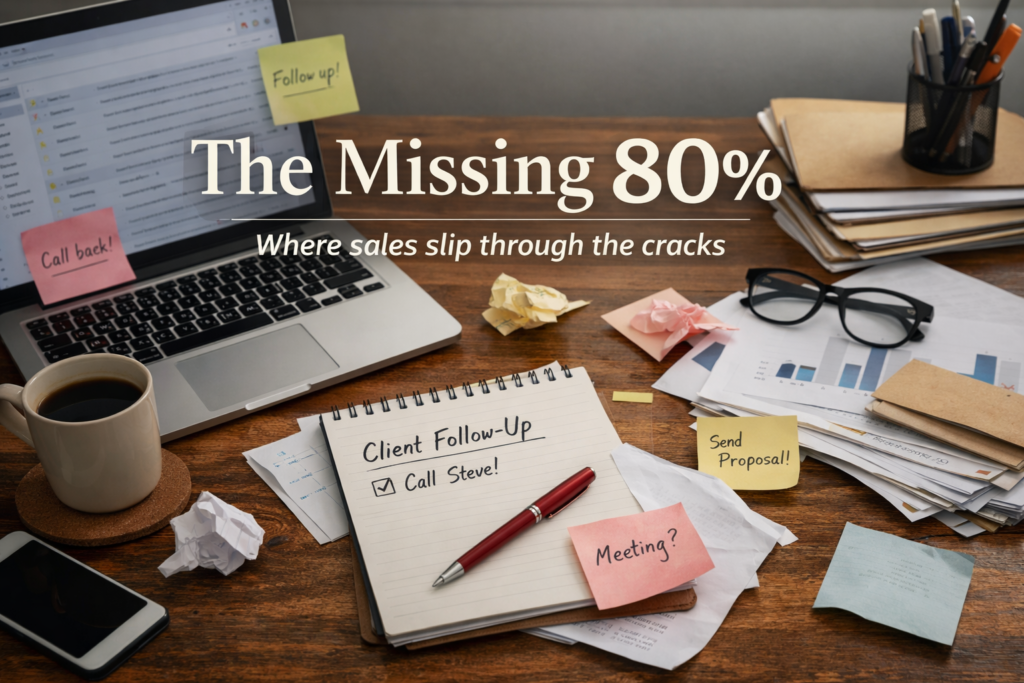
I came across a stat recently that stuck with me: most small businesses lose around 80% of potential sales simply because follow-up slips through the cracks. It’s one of the most common sales follow up mistakes small business owners make, and it often goes unnoticed until deals quietly dry up.
Not because the leads were bad.
Not because the product wasn’t right.
And rarely because people weren’t trying.
It’s usually something far more ordinary.
It’s rarely about effort or lead volume
When sales feel slow, the instinct is often to chase more leads. More ads. More activity.
But for many businesses, the real issue isn’t lead generation. It’s what happens after the first conversation. This is where sales follow up mistakes small business teams fall into without realising it.
A good enquiry comes in.
A conversation happens.
There’s interest on both sides.
Then the call ends, a note gets scribbled down, and the plan is to “follow up next week”.
That’s often the exact moment the sale starts to slip away.
Not because the prospect wasn’t interested.
But because nothing clearly prompted the next step.
Why sales follow up mistakes small business teams make cost more than they realise
Across small teams, the same patterns show up again and again. These are classic sales follow up mistakes small business owners recognise immediately once they see them written down:
Scattered notes
Details live in notebooks, inboxes or spreadsheets. There’s no single view of the opportunity.
Inbox-led selling
Email becomes the sales system. Important follow-ups get buried under day-to-day work.
No clear next action
A good conversation ends without a reminder. The intent to follow up is there, but the prompt isn’t.
No visibility
Without a clear pipeline, it’s hard to see who needs chasing, when, or why.
Nothing feels broken in the moment. That’s why these issues persist.
The real cost of missed sales opportunities
When follow-up slips, it’s not just one sale that’s lost.
It’s the time spent generating the lead.
The effort put into the conversation.
And the opportunity that never got revisited at the right moment.
And when your sales data isn’t joined up with your accounts, it becomes even harder to see which conversations actually turn into revenue — or where deals quietly stall after the invoice stage.
That’s why joining your CRM and accounts, for example through our integration with FreeAgent, gives you a clearer picture of what’s really happening across your pipeline — not just who you spoke to, but who actually paid.
For many businesses, fixing sales follow up mistakes small business teams repeat has a bigger impact than increasing marketing spend.
Why this problem keeps coming back
Small business owners juggle sales alongside everything else. Follow-up often happens in the gaps between meetings, calls and admin.
Many CRMs promise to help, but are too complicated to stick with. So teams fall back to email and spreadsheets. Work still gets done, but visibility disappears.
The issue isn’t motivation.
It’s not having a simple, joined-up way to see what happens next.
How to fix sales follow-up without overwhelm
Stopping the Missing 80% doesn’t require a full overhaul.
In practice, it looks like this:
-
After a call, you can immediately see the next action
-
Every prospect lives in one place, with notes and history attached
-
Follow-ups are prompted, not remembered
-
You can glance at a pipeline and know where things are stuck
When follow-up is visible and obvious, opportunities are far less likely to quietly fade away.
Start the year by fixing the gap
If you want to stop losing leads this year, start by tightening your follow-up. Not by adding more tools, but by making it clearer and easier to manage.
If you’d like to explore this:
👉 Start a free popcorn CRM account and see how simple joined-up follow-up can be
-
👉 Or book a short demo to look at the sales and marketing features in context
No pressure, no hard sell. Just a chance to see whether this approach would work for your business.