
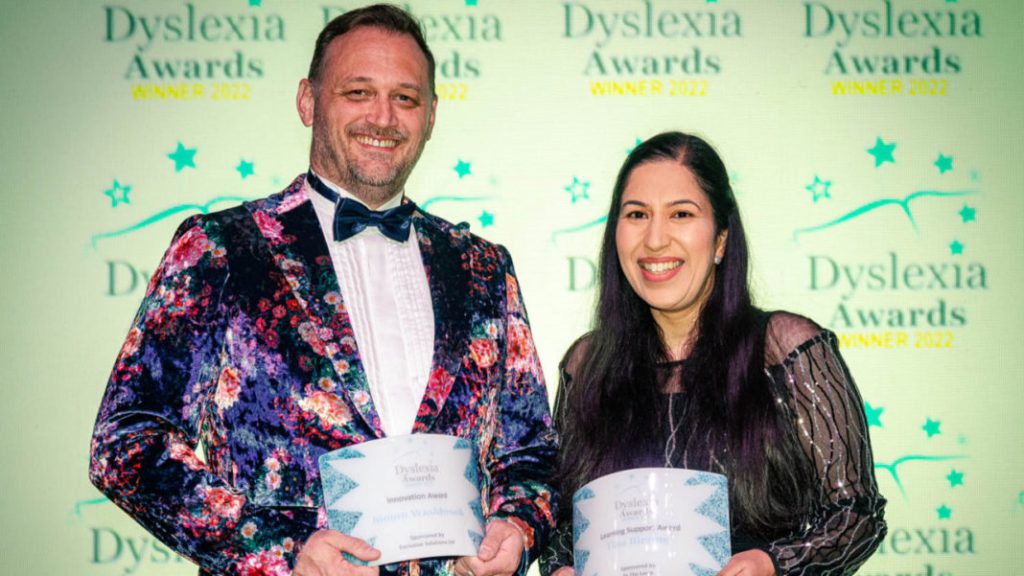
I’ve recently been asked to judge the Innovation Award at the National Dyslexia Awards, and this one means a little more to me than most.
Because the Innovation Award was actually the first award I ever won.
In fact, somehow I managed to come back and win it again the following year!
Now, several years later, I’m sitting on the other side of the table, helping to choose the next winner.
It’s been a good opportunity to think about why that first award mattered so much to me and, more importantly, why recognising people who think differently matters.
It’s also made me think about my own experience of dyslexia in business, and how thinking slightly differently can influence the way you solve problems, spot opportunities and ultimately innovate.
Dyslexia, confidence and doing things differently
Life gives you enough knocks along the way anyway.
When you’re dyslexic and naturally think about things slightly differently, you can probably add a few more to the list.
I’ve never necessarily approached problems in the conventional way. Sometimes that can be challenging.
But in business, I’ve increasingly realised that it can also be a huge advantage.
I love looking at a problem, pulling it apart and asking:
Why does it have to work like this?
That’s been a big part of my approach to building popcorn CRM.
The CRM industry is full of incredibly powerful software with hundreds of features, integrations and options.
But when we spoke to small businesses, that wasn’t necessarily what they wanted.
They wanted something simple.
They wanted to see what was happening with their prospects.
They wanted to know who they needed to follow up.
And they wanted software their team would actually use.
Rather than asking how we could add more, we started asking how we could make things simpler.
Thinking differently became part of the product.
Why recognition matters
That’s why winning my first Innovation Award meant so much.
It wasn’t really about getting a trophy.
It was the recognition.
Someone else had looked at what I’d created, how I’d approached the problem differently and decided it deserved to be recognised.
That meant more than I probably realised at the time.
When you’ve spent years wondering whether you’re doing things the “right” way, having somebody recognise that doing things differently can actually be a strength means a lot.
Sometimes you just need someone else to believe in what you’re doing to give you that little extra belief in yourself.
And that’s one of the reasons being asked to judge the same award all these years later means so much to me.
Why dyslexia in business can encourage different thinking
I don’t think having dyslexia automatically makes somebody innovative.
But I do think there’s something incredibly valuable about having people in a business who approach problems from different directions.
If everybody around a table has the same background, experiences and way of thinking, there’s a reasonable chance you’ll keep arriving at similar answers.
Bring together people who see the problem differently and things start to get interesting.
That’s why I think the conversation around dyslexia in business and neurodiversity generally should be about more than simply accommodating different ways of working.
We should also recognise the value those different perspectives can bring.
For me, being dyslexic means I often need to visualise things. I like making things simple, seeing how different parts connect and finding another way around a problem when the obvious route doesn’t work.
Those characteristics have had a huge influence on the way I’ve approached popcorn.
Sometimes the person sitting around the table asking:
“Why are we doing it like that?”
is exactly the person you need in the room.
Now I’m sitting on the other side of the table
Which brings me back to the National Dyslexia Awards.
This time I’m not entering.
I’m judging.
I recently joined Elizabeth Wilkinson, my fellow judges and award sponsor Nicola Rust to go through this year’s applications for the Innovation Award.
There were some amazing entries.
And, unsurprisingly, we didn’t make the decision quickly.
There was plenty of discussion, but eventually we all agreed on someone we think is a very worthy winner.
Obviously, I’m not telling you who.
You’ll have to wait. 
A full-circle moment
I’ll be at the National Dyslexia Awards in Telford on 17th October, and I’m really looking forward to meeting the finalists and watching someone else receive the Innovation Award.
For me, that’s the best bit.
An award that once gave me recognition for thinking differently has now given me the chance to recognise somebody else for doing exactly that.
Hopefully, whoever wins it this year gets that same little boost I did.
For me, dyslexia in business isn’t about pretending there aren’t challenges. There are.
It’s about recognising that thinking differently can also bring something incredibly valuable to the table.
Because you don’t always have to do things the way they’ve always been done.
Sometimes looking at something differently is precisely where the innovation starts.
Keep being amazing. Keep doing things differently. And believe in yourself.